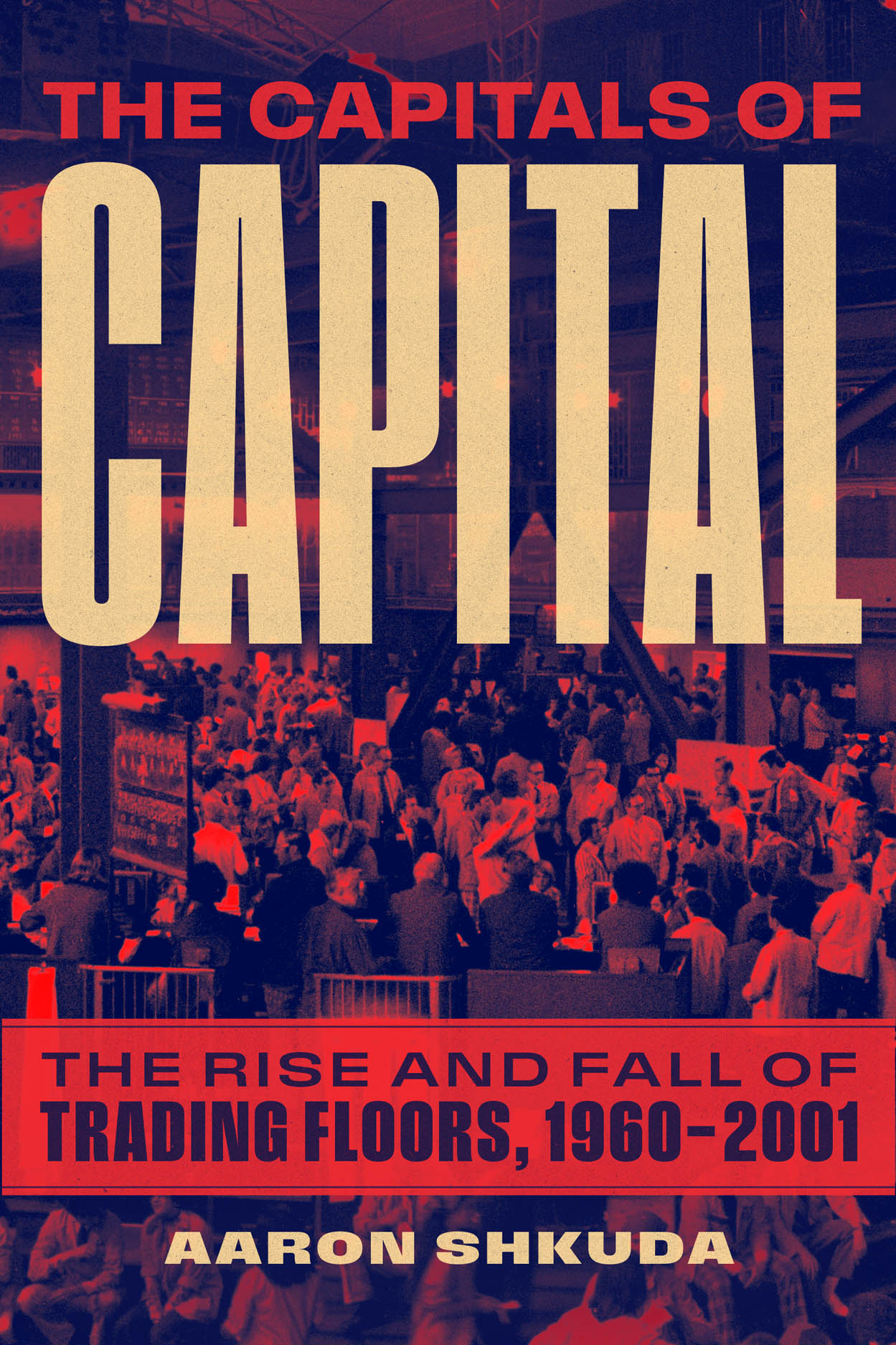
The Capitals of Capital
The Rise and Fall of Trading Floors, 1960–2001
The Capitals of Capital
The Rise and Fall of Trading Floors, 1960–2001
How the transition from physical trading floors to automated ones changed central business districts and urban policy.
Wall Street is defined by the New York Stock Exchange’s headquarters, while the Chicago Board of Trade’s iconic building anchors LaSalle Street in the city’s Loop. These buildings have not moved in a century, but their trading floors have experienced dramatic changes over the past sixty years. While thousands of commuters still work in and around Wall Street, most stocks are traded via computer. Not even the NYSE’s servers are onsite.
The Capitals of Capital charts the rise and dematerialization of stock-exchange trading floors in New York and Chicago, demonstrating how the finance industry has long been entwined with urban planning and development. Aaron Shkuda shows in detail how the industry came to dominate cities both economically and spatially, tracing the demands of firms like Chase Manhattan Bank and the Chicago Mercantile Exchange for larger central facilities, better tax breaks, and other accommodations—until technological developments shifted their priorities from spaces for people to capacity for machines. Shkuda’s history of trading floors reveals financial institutions as change agents in urbanism; through their evolving construction proposals, they forced elected officials, urban planners, architects, and voters to consider the value of trading floors, their significance to a city and its people, and what kind of resources they deserved. Today, as Wall Street towers are converted to apartments and server farms, The Capitals of Capital sheds light on the ever-shifting relationship between the finance industry and urban spaces.
256 pages | 42 halftones | 6 x 9
Historical Studies of Urban America
Economics and Business: Business--Business Economics and Management Studies
History: American History, Urban History

Table of Contents
Introduction
Chapter 1. Financial City, U.S.A.: Trading-Floor Expansion and the Spatial Dynamics of Wall Street, 1960–65
Chapter 2. Transfer Taxes and the Weehawken Stock Exchange: Regional Politics and Capital Mobility
Chapter 3. Anticipating the Future of Futures: The CBOT, the Merc, and Commodities Trading in Chicago, 1970–74
Chapter 4. The Paperwork Crunch and the Automation of Securities Trading
Chapter 5. Cutting the City Out of Trading: The NASDAQ and the Changing Geography of Wall Street
Chapter 6. Consolidation, Competition, and Technology: The Chicago Trading-Floor Building Boom, 1974–94
Chapter 7. The New Wall Street of Jersey City: Transforming the Hudson River Waterfront into New Jersey’s Gold Coast
Chapter 8. Wall Street and Silicon Valley Come to Brooklyn: Building the New Corporate Back Office in MetroTech
Chapter 9. Back- and Front-Office Tax Breaks
Conclusion: The Triumph of the Server and the End of the Trading Floor
Acknowledgments
Notes
Index