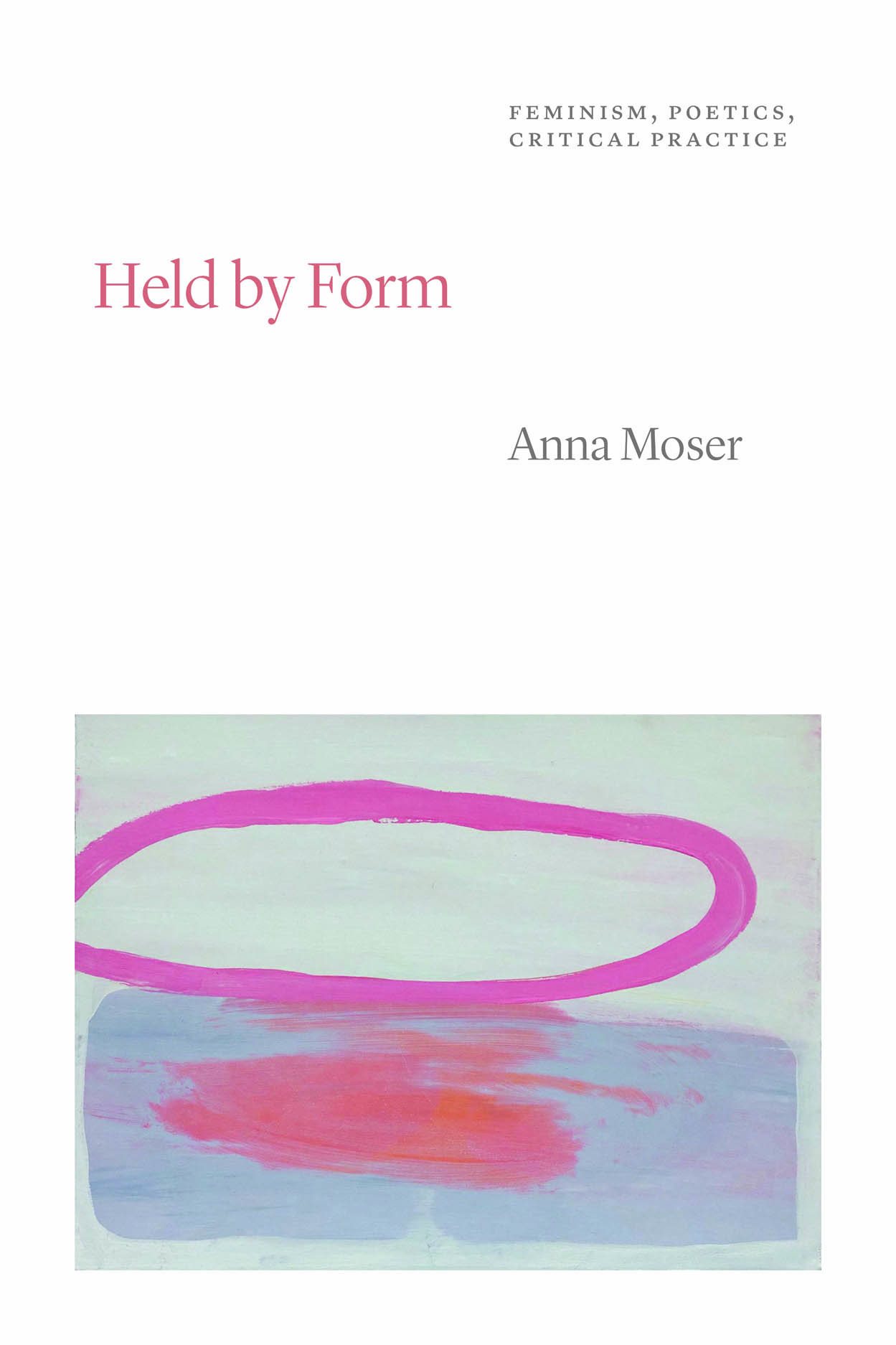
Held by Form

Feminism, Poetics, Critical Practice

Held by Form

Feminism, Poetics, Critical Practice

Publication supported by the Bevington Fund

How contemporary poetry illuminates the workings—and struggles—of commitment in feminism.

In this lucid and vigorous defense of poetics for feminism, Anna Moser situates the practice of contemporary poetry in an exploratory dialogue with the work of philosophical, critical, and historical thinkers—placing Denise Riley in conversation with Judith Butler, Lyn Hejinian with Hannah Arendt, m. nourbeSe philip with Saidiya Hartman, and Susan Howe with Emily Dickinson. 

Moser’s central theme is these poets’ questioning, agonistic commitment to feminism. What, the book asks, does it mean to be committed? How does such a commitment materialize? What are its consequences? What does it mean not to take for granted an affiliation like “feminist” (or even “woman”), but rather to involve one’s art in probing its historical formations, present conditions, and future trajectories? Moser explores both the risks and possibilities of making art in this equivocal condition. She reveals that the poetry of certain contemporary writers not only unfolds within this space of agonistic commitment, but that, in doing so, it offers an important contribution to feminist thinking. Moser’s book also shows that while form is a constraint that limits these poets’ freedom, it also holds them in a more sustaining sense, allowing something belatedly and imperfectly to be said. 

In dialogue with feminist political theory, philosophy, historiography, and aesthetics, Held by Form reveals poetics as a unique mode of critical practice: one that models relations of care and collectivity, refigures inherited forms in ways that contest their hierarchies of value, and responds with generosity and openness to the complexities of living in gender.


224 pages | 10 halftones | 6 x 9 | © 2026

Thinking Literature

Literature and Literary Criticism:

Reviews

“Feminism is full of unsettled but defining debates. Held by Form turns to poetry to expand and complicate these debates. Reading Susan Howe’s textual alternatives, Lyn Hejinian’s own doubt about whether her poetic instincts are shaped by being a woman, m. nourbeSe philip’s reckoning with the archive and the law, and Denise Riley’s account of the poem that ‘hammers itself out’ on its maker, Moser shows that poetry doesn’t provide pithy, one-dimensional answers—instead, it works through contradictions rather than settling them. The result is a rigorous defense of poetry’s role in shaping feminist inquiry.”

Juliana Spahr, winner of the 2026 Pulitzer Prize in Poetry

“Held by Form is a singularly bracing work of criticism. Like the work of the poets she addresses, Moser’s readings are variously unsettling, beautiful, thorny, and persuasive: one need not choose. Poetics becomes the site of difficult, sometimes exhilarating, possibility. Subtle and incisive, Held by Form sounds out the territory between—and within—commitment and conscription. This book is both utterly absorbing and exemplary: its readings are revelatory and reverberant, its methodological disposition both fierce and friendly.”

Maureen N. McLane, author of "My Poetics"

“Moser’s Held by Form offers a vital new consideration of the itineraries of feminist practices in the twentieth and twenty-first centuries and a significant exploration of feminism’s forms and logics across works by canonical poets of the past few decades. The book presents inventive readings of the formal and philosophical thought that emerges in these feminist texts and dialogues.”

Margaret Ronda, author of "Remainders: American Poetry at Nature’s End"

“Held by Form offers a fresh account of agency drawn from both the dilemmas of critical reading and the constraints of poetic composition. Moser’s readings of feminist poetics consistently surprise as she works through the ambivalences of thinking political theory and poetic practice together.”

Samuel Solomon, author of "Lyric Pedagogy and Marxist-Feminism"

Table of Contents

List of Figures


Introduction: Held by Form
1. The Variant: Form as Deliberative Practice
2. Critical Practices of the Figure: Contesting Formalization
3. The Poetics of Natality: Form as Constructive Principle
4. Resignifying Lyric: Feminist Styles of Immanent Critique
Coda: The Pont Neuf Wrapped


Acknowledgments
Notes
Bibliography
Index 
 

Be the first to know

Get the latest updates on new releases, special offers, and media highlights when you subscribe to our email lists!

Sign up here for updates about the Press