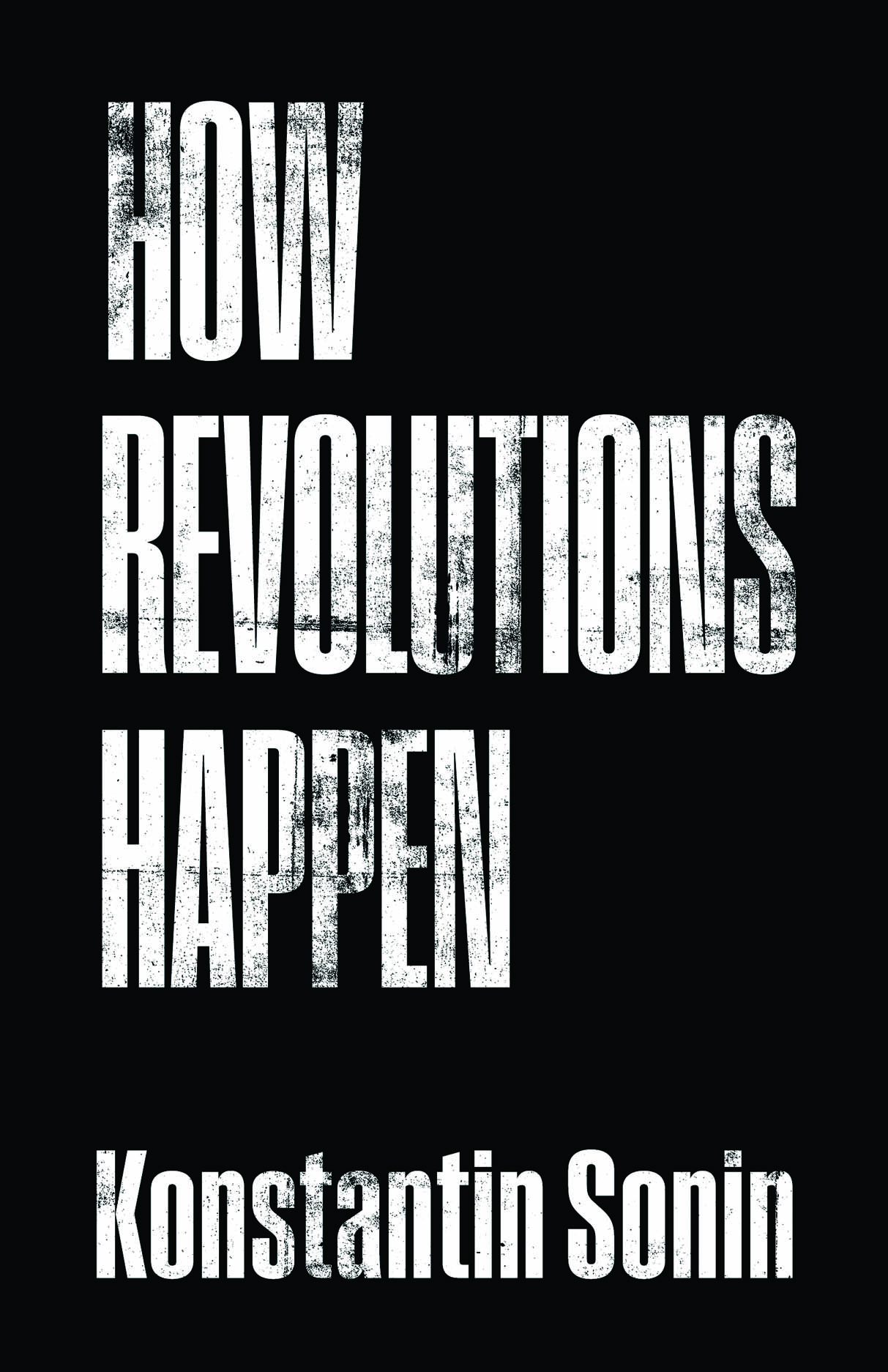
How Revolutions Happen

From the Russian intellectual-in-exile Konstantin Sonin, a grand theory of when and how rapid political change happens—or doesn’t.

In 2015, economist Konstantin Sonin solidified his status as an enemy of the Russian state when he published an article predicting that Vladimir Putin’s presidency would produce the country’s third revolution by the middle of this century. Forced to flee the country, Sonin settled in Chicago. In the decade that followed, the Russian government continued to pursue him—placing him on their state wanted list, tracking his movements, and sentencing him in absentia to eight years in prison. Sonin’s research and political advocacy continued unabated. So did his writing.

Now, Sonin has completed his masterpiece: a revelatory and sweeping investigation of a timeless question—what makes a revolution? How Revolutions Happen pinpoints why they arise, why they don’t, and where they’re likely to occur next. Tracing examples of successful and failed examples from history—in China, France, Haiti, Ukraine—Sonin shows that revolutions don’t grow out of mere popular unrest; they happen when states cease to evolve. This argument extends well beyond why nations fail, considering also why nations almost fail and why other nations fail repeatedly. Drawing on both empirical evidence and his firsthand experience, he also argues that although revolutions are an important part of human societies, they are not inherently good or bad—or quick to end.

Wry, sweeping, and erudite, How Revolutions Happen recasts everything we think about political change. From one of the world’s foremost political economists, this book is a momentous cumulation of knowledge that allows us to fully understand what a revolution is, why they occurred in the past—and how to measure where they might be coming.


272 pages | 19 color plates, 6 tables | 6 x 9

Economics and Business: Economics--History

Reviews

“A milestone—a parsimonious theory of revolutions written by the most prominent formal theorist of the phenomena. A rare combination of analytical clarity with historical depth and erudition.”

James A. Robinson, coauthor of Why Nations Fail and winner of the Nobel Prize in Economics

“The best book on revolutions I have read in decades. In the spirit of Skocpol, Tilly, and Huntington, Sonin offers both an elegant theory and a sweeping narration of hundreds of years of revolutionary history—jumping seamlessly from the French Revolution to the Second Russian Revolution, peppered between with vignettes from lesser-known revolutions, including those that failed. How Revolutions Happen is a must-read for anyone interested in social movements and political change.”

Michael McFaul, author of Autocrats Versus Democrats

“Drawing from centuries of history, How Revolutions Happens is an outstanding synthesis of both the historical events themselves, and the later attempts to explain how and why they happened. Sonin has given us an incredibly valuable single volume resource that provides a solid grounding for the topic and a springboard for further inquiry. Highly recommended.”

Mike Duncan, author of Hero of Two Worlds: The Marquis de Lafayette in the Age of Revolution

“History is punctuated with revolutionary moments—events that seemed impossible the day before and inevitable the day after. Sonin offers a deeply insightful guide to the causes and consequences of these moments.”

Roger Myerson, winner of the Nobel Prize in Economics

“Deep, sweeping, and highly readable, this global history of modern revolutions offers hope to those living under authoritarian rule and a warning to those who take their democracies for granted. Sonin demonstrates that revolutions occur when political systems become calcified and cease to respond to the changes around them. This has happened—and can happen—to authoritarian regimes and democracies alike. We should remember that."

Serhii Plokhy, author of The Russo-Ukrainian War: The Return of History

“Scholarly research on revolutions ran out of ideas some fifty years ago. This book will undoubtedly spark its resurgence. Brimming with ideas, erudite, and eloquently written, it redirects our attention back to these history-shaking political events and provides a framework for analyzing what may be looming in several countries where ossified regimes stifle the popular demands.”

Adam Przeworski, author of Crises of Democracy

“Reading it as a Russian, I could not help thinking about my own country. In a place where political change has come to seem almost unimaginable, the question of how seemingly stable systems begin to crack feels especially urgent.”

Yulia Navalnaya, Russian political activist

“In 1991, many believed Russia’s transformation was irreversible. They were wrong about how fragile new institutions can be. Sonin’s book explains why: toppling a dictatorship is not the same as building a democracy, and latecomers and opportunists often inherit the revolution. For the people of Russia, Iran, Venezuela, and every country still living under tyranny, this is a guide to how revolution happens and what comes after, with a prescient warning about what not to repeat.”

Garry Kasparov, chairman of the Renew Democracy Initiative

“A rich, great read—though the message is somber: revolutions take place when extractive and exploitative economies operate in rigid political systems. Though revolutions break through this impasse and cause profound change, they usually end up institutionalizing a new kind of extractive state. A must-read for those interested in how our political institutions change, and why the new ones are often disappointing.”

Susan Stokes, author of The Backsliders: Why Leaders Undermine Their Own Democracies

“Sonin, to no surprise, produces a sweeping, razor-sharp guide to how revolutions really work—rooted in institutions, not slogans. Sonin seamlessly blends vivid history with clear political economy to show that upheaval is decades in the making. His analysis cuts through the noise, distinguishing genuine institutional change from street drama and palace swaps. It is essential reading for leaders and citizens seeking to recognize the sparks—and the kindling—of revolution.”

Nancy Qian, Northwestern University

Table of Contents

Preface
Timelines of Major Revolutions

1. Revolutions Are Forever
2. A Unified Theory
3. The Great Revolutions
4. The Eternal Desire to Be Free and Independent
5. Catastrophes That Didn’t Happen
6. Mechanics of Revolution
7. The Powerful Protect Their Power
8. On Leaders
9. On the Day It Happens
10. All Tomorrow’s Revolutions

Acknowledgments
Chapter Sources
Bibliography
Index

Be the first to know

Get the latest updates on new releases, special offers, and media highlights when you subscribe to our email lists!

Sign up here for updates about the Press