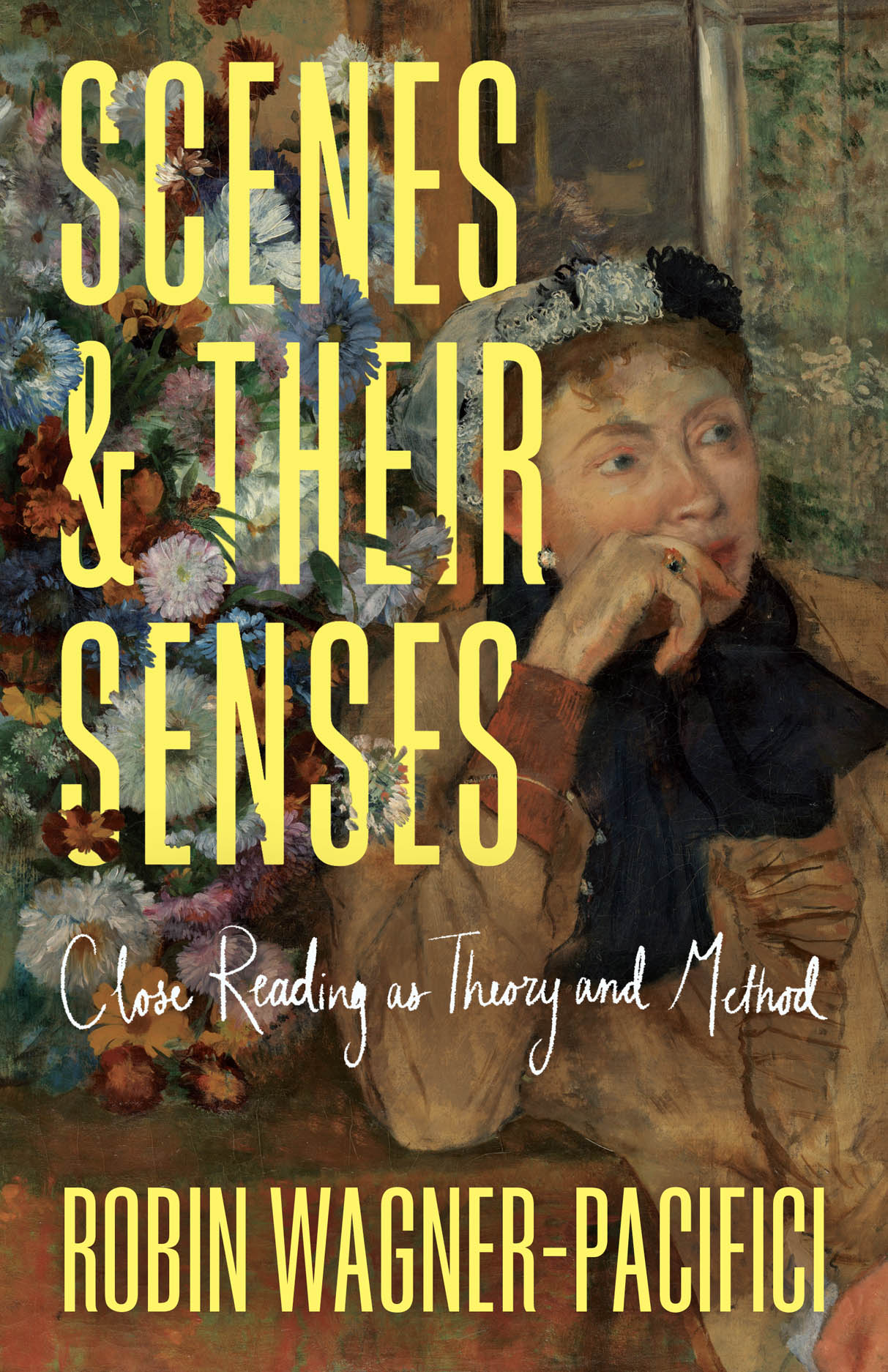
Scenes and Their Senses
Close Reading as Theory and Method
Scenes and Their Senses
Close Reading as Theory and Method
Makes the case for close readings of small scenes appearing in works of literature, scholarship, film, and visual art, showing how close attention to details can reveal the meaningful sociological action that often occurs on the margins.
Why do certain images, stories, and scenes impress upon us so strongly, inviting us to linger over the nuances of their meaning? In Scenes and Their Senses, sociologist Robin Wagner-Pacifici seeks to uncover the deeper meaning behind twenty “scenes” that have captured her theoretical imagination over her lifetime. Some of these come from classics of sociological theory or literature—Geertz, Habermas, Lévi-Strauss, Zola—and some are more contemporary, including the films Good Will Hunting and Luis Buñuel’s The Phantom ofLiberty. She seeks here to understand each scene less as examples of a given condition or conundrum and more as worlds in themselves.
As Wagner-Pacifici shows, close attention to the forms and flows of these minor, often quiet scenes reveals how meaningful action occurs in what might appear to be the margins or interstices of the bigger, noisier story being told. Providing an entry point to larger social conditions, relations, and change, the scenes analyzed here evoke sociological themes of belonging and exile, strength and weakness, cleanliness and pollution, reality and fantasy, courage and cowardice, and vision and obscurity, among others. As an ethnography of texts recalled from previous readings and revisited by the author, the scenes highlight the role of memory in sense-making. Furthermore, the activation of the scenes as a focused point of sustained contemplation functions as a remarkable bridge between method and theory.

Table of Contents
Introduction
The Scenes
1. Form and Flow: Claude Lévi-Strauss, Totemism
2. The Pause and the Turning Point: Henry James, Portrait of a Lady
3. The (Potential) Commotion of Objects: Luc Boltanski and Laurent Thévenot, On Justification
4. Not by Compassion but by Power: Frederick Douglass, Narrative of the Life of Frederick Douglass
5. Dirt and Disorder: Mary Douglas, Purity and Danger
6. Democracy and Drink: Jürgen Habermas, The Theory of Communicative Action
7. Animal Spirits in the Drawing Room: Jane Austen, Pride and Prejudice
8. The Fierce Visibility of Eviction: Ralph Ellison, Invisible Man
9. The Indifference of Nature as Our Salvation: Anton Chekhov, “The Lady with the Pet Dog”
10. The Familiar Problem: W. E. B. Du Bois, The Souls of Black Folks
11. Shrapnel and World History: Matt Damon and Ben Affleck, Good Will Hunting
12. Laundry and Languidness: Émile Zola, L’Assommoir
13. Venturing into the Poetic State: Paul Valéry, “Poetry and Abstract Thought”
14. Semiotic Vibrations of the Fourth Estate: Giuseppe Pellizza da Volpedo, Il Quarto Stato
15. Self-Possession and Illumination: John Milton, Paradise Lost
16. Exotic Customs Down the Hall: Luis Buñuel, The Phantom of Liberty
17. The Storyteller’s Message: Walter Benjamin, “The Storyteller”
18. Diffidence as a Vocation: Clifford Geertz, “Deep Play”
19. Relationships Seeking a Form: Italo Calvino, Invisible Cities
20. A Story Both True and Unreal: Roland Barthes, Mythologies
21. Existence as a Question: John Berger, Ways of Seeing
Conclusions: Themes, Moods, Emotions, and Scenic Flows and Forms
Postscript: Connection and Separation: Georg Simmel, “Bridge and Door”
Acknowledgments
Notes
References
Index