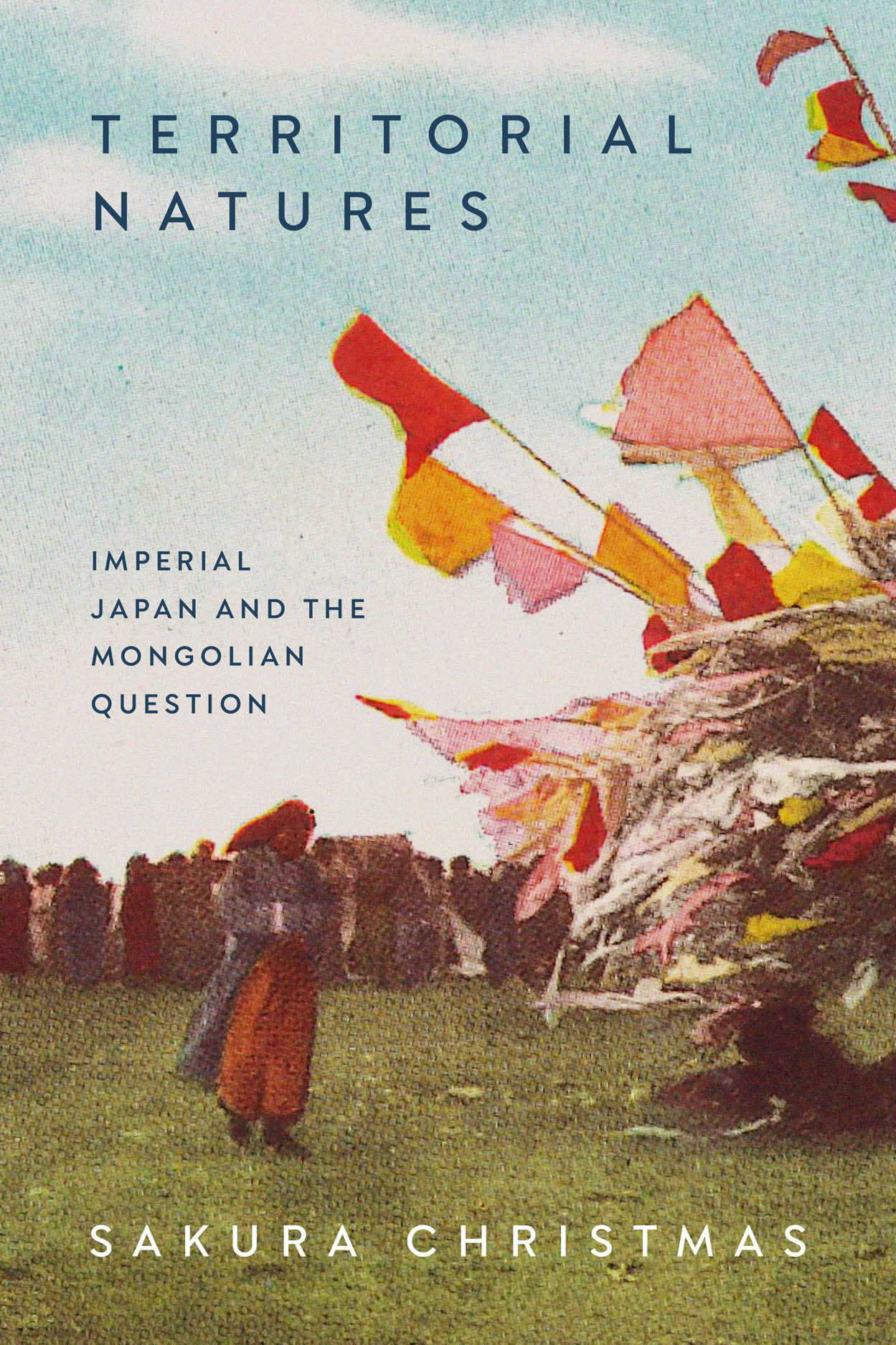
Territorial Natures
Imperial Japan and the Mongolian Question
Territorial Natures
Imperial Japan and the Mongolian Question
A critical account of the Japanese occupation in Inner Mongolia.
Early in the twentieth century, the steppe borderlands between China and Mongolia erupted in violence. As imperial Japan expanded into the area, this crisis between nomadic and settler communities posed fundamental problems in governance. In response, Japanese and Mongol leaders together proposed a radical solution: demarcating an autonomous region in Manchukuo for minority peoples, a new kind of political space that would later define the territorial structure of Communist China.
In Territorial Natures, Sakura Christmas explores how the fraught partition of this autonomous region warped the ethnic and environmental boundaries of Manchukuo. She challenges its origin story as a socialist invention by the Chinese state, instead seeing it as also a fascist extension of the Japanese occupation. By reading Chinese and Mongolian sources against Japanese archives, Christmas reveals how this contested history seeded the volatile landscape of autonomous regions in the People’s Republic of China today.
344 pages | 4 color plates, 23 halftones, 2 tables | 6 x 9 | © 2026
Asian Studies: East Asia, General Asian Studies
Geography: Cultural and Historical Geography, Environmental Geography
History: Asian History, Environmental History, General History
Reviews

Table of Contents
Illustrations
Conventions
Introduction
Part One: Naturalizing Territory
Chapter One: Unsettling the Nomadic Steppe
Chapter Two: Demarcating Ethnic Autonomy
Chapter Three: Drafting Land Reform
Part Two: Territorializing Nature
Chapter Four: Exhausting Elements of the Earth
Chapter Five: Fixing Pastoral Life
Afterword
Acknowledgments
Appendix A: Counties in Kingġan Province and the Former Bannerlands (ca. 1934)
Appendix B: Province and League Jurisdictions of Banners (ca. 1890–1940)
Notes
Bibliography
Index